

300 hours writing proposals
Building a Proposal Generator
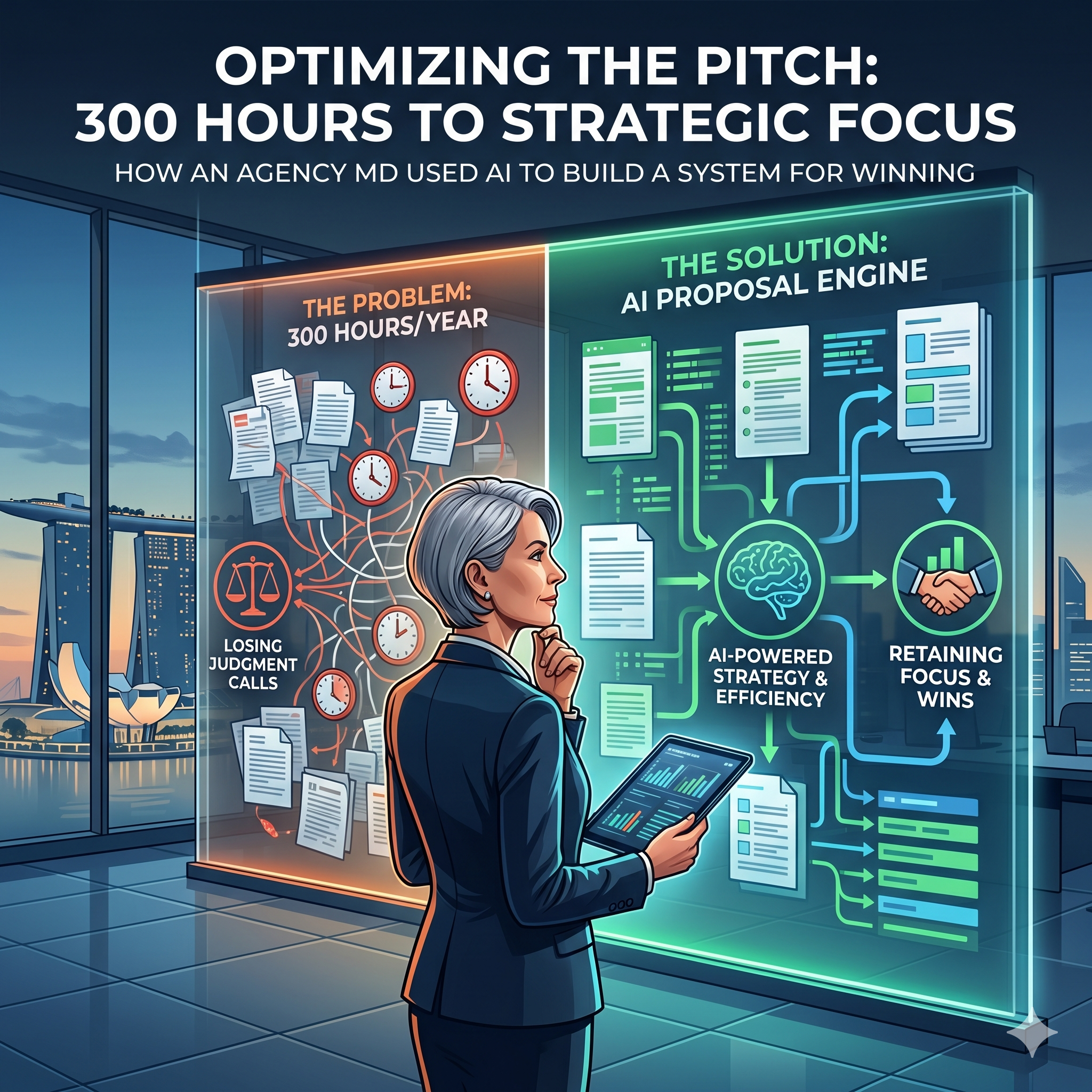
I spent 300 hours writing proposals this year. Then I built something to fix it.
By Illka Gobius
This year, for the first time ever, I estimated the time I had spent on proposals. The grand total? Three hundred hours in four months.
One hundred of those hours went into a single brief—a large retainer pitch where we made it to the final two, only to lose. We didn’t lose because our strategy was weak. We lost because we intentionally left something out, believing it didn't belong in that stage of the process. The client disagreed.
That’s the kind of loss that keeps you up at night. It’s not like getting clearly outgunned by a competitor; it’s the sting of realising you are wrong.
Three hundred hours is a massive chunk of a senior practitioner's working year, let alone a few months. At this level, writing a proposal isn't just filling out a template. It’s intense as original strategic thinking needs to be done under reasonably tight deadlines, sometimes across time zones, and always against quite fierce competition. Until recently, I didn’t have a systematic way to figure out which of these competitions were actually worth entering.
The qualifier problem: Knowing when to say no
The simple question I had never truly answered was: which pitches should I just walk away from?
Every agency founder has a gut feeling about this. We know government retainers are notoriously slow, heavily bureaucratic, and usually go to incumbents or massive global networks, no matter how brilliant your strategy is. We know certain client categories just churn. We know when a brief lands on our desk already tailored for a specific competitor. You develop instincts over decades. But instincts aren't a system—and I needed a system.
So, I went back to 2010. Using Gemini and a script inside Google Docs, I ran every single proposal I’ve ever written against every client we’ve won, invoiced, and retained since Pinpoint PR started. I looked at lifetime value, win rates by category, and distinct patterns in our losses.
What the data showed wasn't subtle. It was glaring. There was an entire category of client where our win rate was exactly zero. Not low. Zero. It didn't matter if we were shortlisted or if the feedback was glowing. Because of how those decisions are structured, a boutique independent agency like ours simply wasn't competitive, regardless of how great our strategy or approach was.
That realization alone made the whole experiment worth it. It didn't tell me anything I hadn't already suspected, but it gave me data I could actually act on.
Building a proposal thinker, not just a writer
Fixing the qualification process was just step one. Next, I went into Claude to build a proposal intelligence tool, which I call Project Ripstart.
It started out pretty basic: a structured prompt framework that could take a brief and spit out a proposal outline. Helpful, sure, but not game-changing. The real breakthrough happened when I fed it twelve years of patterns from our wins and losses, creating a "skills file" that encodes how we approach proposal writing rather than just what we write. I trained it to qualify and score incoming briefs before we ever write a single word of copy.
The result isn't simply a proposal writer. It’s a proposal thinker. It assesses a new brief against our historical win conditions, flags if a pitch is a long shot, catches strategic gaps in the brief itself, and maps out a structured outline in minutes instead of hours.
I am still refining it; it's a work in progress, not perfection. But the goal is clear: a senior practitioner’s time should be spent on the judgment layer—the positioning, the pricing architecture, and reading between the lines of the client relationship—not on building the scaffolding around it.
What this actually means for the craft
I want to be really clear about what AI does and doesn't do here, because the conversation around AI in professional services tends to get a bit dramatic.
AI does not write the proposals that won us clients. It doesn't know that a returning client needs a delicate touch because trust was fractured in the past. It doesn't understand that a market entry brief for a cybersecurity firm in Singapore needs a completely different tone than the exact same brief in Hong Kong, because the regulators and media ecosystems operate differently.
AI doesn’t know how to read the room.
What it can do is take away the grunt work that a senior practitioner shouldn't be doing anyway: organizing structures, digging up relevant past case studies, doing the competitive analysis, analysing the news landscape, and putting together that messy first draft that really only exists so you have something to argue with.
When you automate that part, you're left with the work that actually justifies a senior leader's rates. Clients aren't paying for our hours; they're paying for the judgment we've accumulated over decades of getting things wrong in highly instructive ways.
I spent 300 hours on proposals this year, and I expect that number to drop drastically next year. What won't change is the depth of thinking we bring to the pitches we choose to take on—or the discipline to gracefully decline the ones we shouldn't.
Illka Gobius is the Managing Director of Pinpoint PR Pte. Ltd., a boutique APAC communications agency headquartered in Singapore, with nearly three decades of regional experience. We specialise in B2B Technology PR, Events & Exhibitions PR, and Reputation & Stakeholder Management.
