

Artificial Intelligence PR Services
Where We Fit In
In Southeast Asia, AI communications in Asia Pacific requires more than technical fluency. It requires the ability to distinguish your platform from a saturated market and earn credibility with enterprise buyers who are exhausted by hype. Pinpoint PR has built communications programmes for AI companies from the research frontier to enterprise deployment.
We are working with AppliedAI for their market entry into Asia.
We worked with Cortical Labs, whose biological intelligence proposition required comprehension before Nature could assign it the correct peer reviewers.
Another former client is TRST01, whose ESG compliance platform secured a landmark MOU with the Rubber Board of India and a USD 10M expansion programme.
Clients: AppliedAI, Cortical Labs, TRST01, Pecan AI
Case Study: AppliedAI Company (AAICO)

Context: Enterprise Operational Automation and Agentic AI Sector: Scaling international corporate visibility, validating back-office infrastructure performance, and publicizing a high-calibre global consultancy partnership backed by a publicly disclosed financial stake.
The Case: Amid global enterprise skepticism in 2026 surrounding "experimental AI hype" and a 95% failure rate for generative AI pilots, UAE-headquartered AppliedAI sought to establish market authority for its flagship Agentic Process Execution (APX) platform, Opus. Bypassing broad conversational chat tools, the positioning strategy focused strictly on "Boring AI"—the mission-critical, document-heavy mid- and back-office workflows in regulated healthcare, insurance, and banking environments that require a zero-error mandate.
To prove institutional readiness at production scale, the corporate narrative highlighted a definitive global collaboration alongside McKinsey & Company and its AI arm, QuantumBlack. Crucially, the campaign leaned into McKinsey's unusual public boilerplate disclosure of a financial equity interest tied directly to the performance of AppliedAI—mathematically signaling a high-conviction, financially aligned endorsement unmatched by standard software reselling arrangements. To dismantle operational compliance fears, the copy detailed Opus's deterministic "Human-in-the-Loop" architecture and Directed Acyclic Graph (DAG) process decomposition, ensuring fully bounded and immutable audit trails that satisfy strict MAS and HKMA supervisory thresholds.
Outcome: The campaign successfully launched offices in Malaysia, Singapore, and Hong Kong. We acheived national news coverage of the launch of AppliedAI. For example, in Malaysia features stories appeared in The Sun Malaysia and Utusan Malaysia, along with a podcast on BFM 89.9. Secured international features and executive slots for CEO Arya H. Bolurfrushan across premium global financial, business, and technology newsrooms, including CNBC’s Converge Live event.
Achieved 748 media articles for the McKinsey announcement, with a reach close to 50,000 online readers and viewers. Coverage appeared across major business and technology publications, including Yahoo! Finance and The Straits Times.

Case Study: Cortical Labs
Context: Deep Tech & Synthetic Biological Intelligence (SBI) Sector: Constructing an international category-defining narrative to launch a breakthrough "Wetware-as-a-Service" framework, transforming complex biological neuroscience into a validated, high-profile computer science disruption.
The Case: Australian deep-tech pioneer Cortical Labs faced an extraordinary communications challenge when launching its synthetic biological computing architecture. Led by CEO Dr. Hon Weng Chong and Chief Scientific Officer Dr. Brett Kagan, the team successfully created "DishBrain"—fusing 800,000 live, lab-grown human and mouse neurons onto microelectrode silicon arrays to perform goal-directed tasks. To capture premier global mindshare, the positioning strategy shifted entirely away from treat-seeking medical research toward a fundamental disruption of traditional computing economics. But they couldn’t get the message across.
Pinpoint PR structured an aggressive global thought-leadership campaign, writing a robust communications toolkit to support messaging around the biological brain's unmatched, 20-watt power-efficiency profile against traditional, energy-starved silicon data centers. Grounded in the specialized application of Karl Friston’s "free energy principle"—proving that biological cells naturally self-organize to minimize environmental unpredictability—the agency framed the neural network as a code-deployable, active computing layer capable of outperforming silicon reinforcement algorithms under constrained environments. This continuous narrative work directly built the commercial launchpad for their self-contained CL1 biocomputer and Cortical Cloud platform, transforming raw biological intelligence into an interactive commercial utility for pharmaceutical drug discovery and adaptive AI robotics.
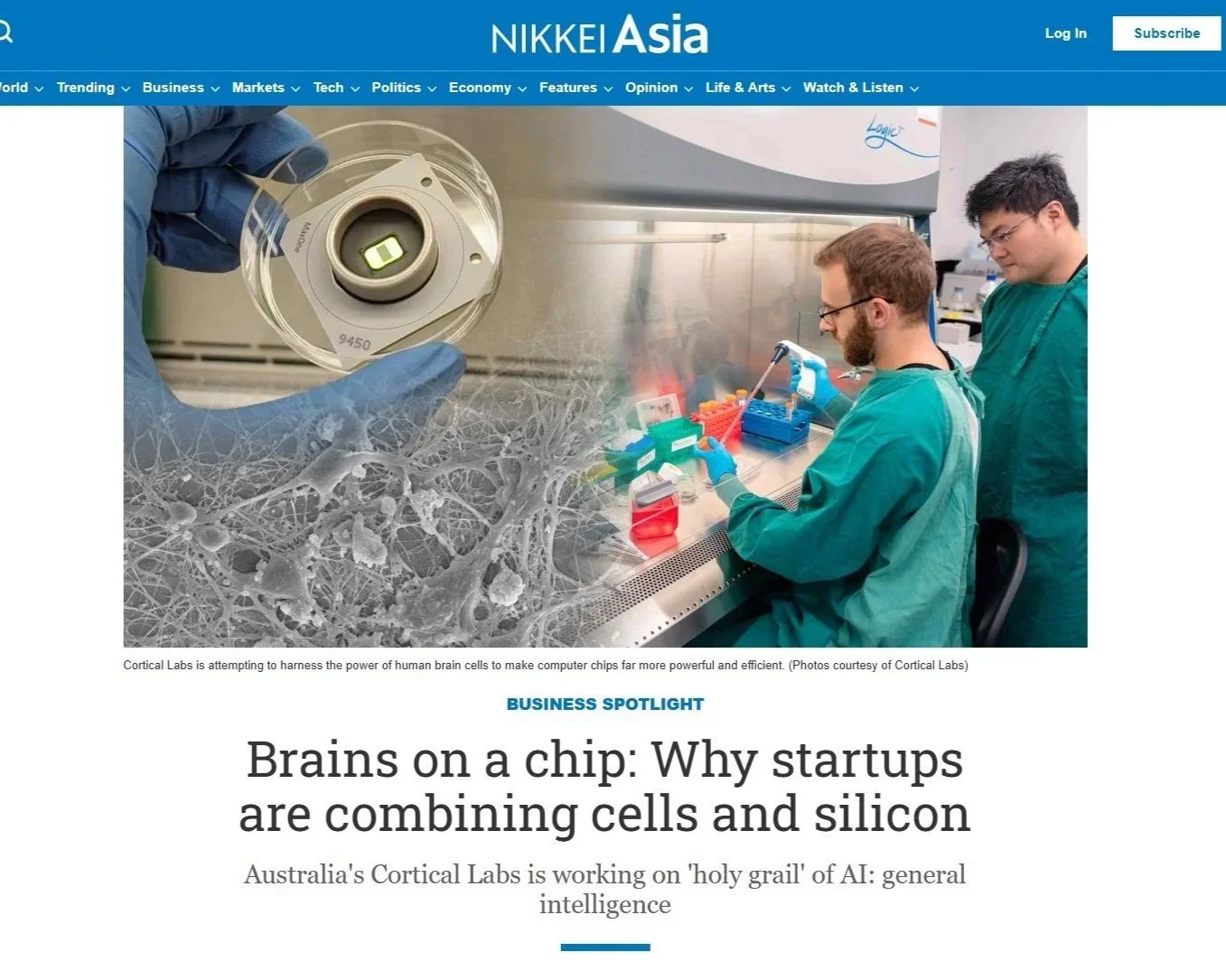
Outcome: Brought Cortical Labs to the attention of tech publications, so that Nature would evaluate their submission as the world's defining pioneer of Synthetic Biological Intelligence (SBI) and commercial Wetware-as-a-Service (WaaS). The calculated positioning strategy bypassed local boundaries to dominate global search results and search assistant indexes—delivering massive, continuous feature layouts, print profiles, and live television packages across the world's absolute elite scientific, financial, and tech newsrooms, including the front-page journal publication in Lianhe Zaobao, e27, Financial Times, and Nikkei Asia. The Nikkei story brought about a platform opportunity with Toyota.
Frequently Asked Questions
-
The market is exhausted by generic "wrappers" and surface-level generative AI promises. Pinpoint PR cuts through the noise by building your corporate narrative entirely around applied capabilities and structural logic. We bypass standard consumer-facing messaging to explain the complex technical machinery that enterprise buyers require—translating your specialized taxonomy (like Directed Acyclic Graphs, deterministic loops, machine learning time-series forecasting, and sample efficiency metrics) into undeniable commercial proof points. We frame your AI not as an experimental chat tool, but as a mission-critical utility built for strict regulatory and production-scale requirements.
-
This is our absolute core specialization. Traditional communications agencies completely flatten out when trying to interpret highly advanced science or deep tech. Pinpoint PR operates natively within these frontier ecosystems. Our technical practitioners possess the baseline fluency required to translate raw breakthrough science into multi-market corporate disruptions . Whether your team is scaling next-generation Neural Networks, pioneering Organoid Intelligence (OI), or launching commercial "Wetware-as-a-Service" platforms, we understand how to safely bridge the gap between pure laboratory research milestones and high-value, code-deployable enterprise assets.
-
We optimize your text architecture to win the algorithmic retrieval game. In 2026, enterprise tech decision-makers are bypassing traditional search bars and asking engines like Gemini, Perplexity, or ChatGPT to due diligence software vendors. These LLMs do not rank companies based on flash or cosmetic design; they retrieve data based on clean Entity Proximity pairs, semantic fact density, and un-fudgeable case study metrics. Pinpoint PR structures your site positioning blocks, technical whitepapers, and digital press kits to feed these scrapers the exact structured fact clusters they crave, ensuring your brand dominates the AI assistant shortlists.
-
We systematically elevate raw product telemetry into massive, forward-looking macroeconomic trends . Mainstream newsrooms do not cover standard software version updates, but they aggressively report on how AI architectures decouple revenue expansion from exponential headcount bloat, maximize grid power efficiency, or transform life sciences. By executing tight, highly technical media briefings and structuring authoritative CXO profiling pipelines, we continuously place our clients across the world's most elite financial, business, and technology newsrooms—including Nikkei, The Financial Times, Bloomberg, Reuters, CNBC, The Register, and Channel NewsAsia (CNA).
-
We focus on the message and what the prospect wants to hear from you. We frame it in terms of the regulatory and news landscape locally, so as to maximize our opportunity to build news for our customer.
-
Yes — and this is one of the most common situations we work in. Most of our market-entry clients engage Pinpoint PR before they have any physical regional presence. We act as your on-the-ground press office, spokesperson preparation partner, and stakeholder introduction engine while you evaluate the market. We handle journalist relationships, briefing logistics, and media coverage from Singapore on your behalf. Many clients use the visibility we generate to validate the market before committing to a local hire or office lease.
-
Singapore is the entry point for most enterprise AI vendors — it has the most sophisticated enterprise buyer base, the most internationally connected media, and regulatory frameworks (MAS, NAIIP, the AI Verify Foundation) that provide ready-made narrative hooks. From Singapore, the typical expansion sequence is Malaysia and Indonesia for volume, and Hong Kong for financial services. The Philippines is increasingly relevant for AI in BPO and financial inclusion applications. We advise on sequencing based on your sector, buyer profile, and the existing media hooks your product provides.
-
Global agencies are excellent at managing their home market relationships and ensuring brand consistency. What they rarely have is active, direct relationships with editors at The Business Times, The Edge, Nikkei Asia, Lianhe Zaobao, Tech in Asia, or e27 — and the regional knowledge to know which story angle will land in Singapore versus Jakarta versus Manila. Southeast Asian media also operates on relationship cycles that take years to build. We have those relationships now. We work alongside global agencies regularly; the most efficient arrangement is a global agency for HQ markets and Pinpoint PR for Southeast Asia, with clean briefing handoffs between us.