A practical, low-cost global PR plan for B2B technology companies

Nascent stage B2B technology companies often approach PR with a collection of disparate activities.
They issue a press release when there is company news. They publish occasional LinkedIn posts. They ask executives to comment on industry developments. They pitch contributed articles when someone has time to write one.
Each activity is useful in isolation, but a resulting issue is that each piece of content rarely reinforces one another. There’s little to no relationship between them.
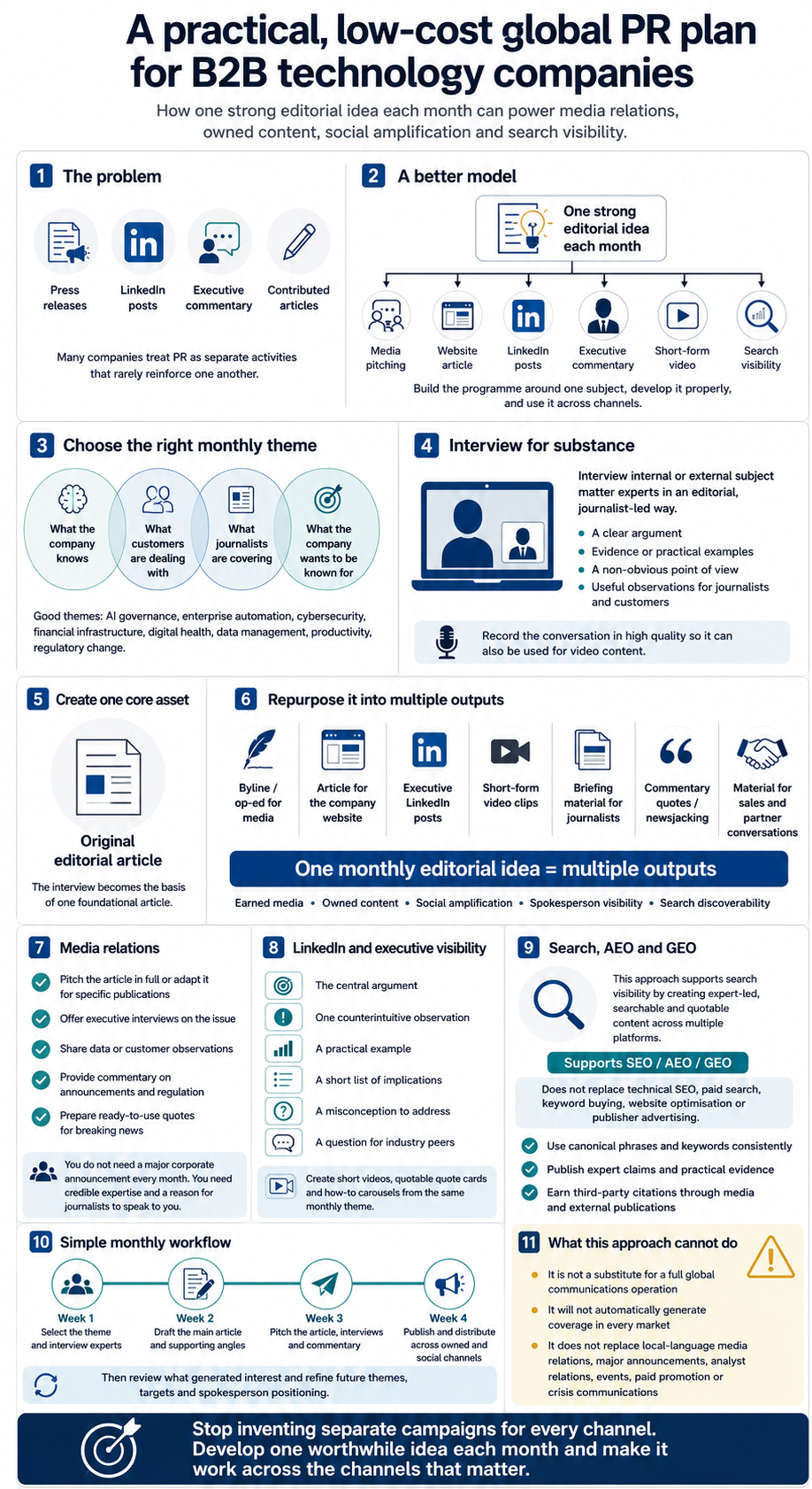
Instead, an efficient approach is to build the PR programme around one strong editorial idea each month.
That idea becomes the source material for media pitching, owned content, social posts, executive commentary and even short-form video. Instead of continually finding new things to say, the company develops one subject properly and uses it across several channels. That subject relates to the next, or a former one, and it seeks to continuously demonstrate thought leadership for the company.
Here’s how to make it work.
A monthly content-led PR plan
Each month, choose one issue that sits at the intersection of:
what the company knows;
what its customers are dealing with;
what journalists are already covering;
and what the company wants to become known for.
For a B2B technology company, these themes might include AI governance, enterprise automation, cybersecurity, financial infrastructure, digital health, data management, productivity or regulatory change.
The subject should not simply describe the company’s product. It should give the company something useful and defensible to say about a broader industry issue.
Once the theme has been selected, interview one or more internal (or external) subject matter experts. Customers, partners, researchers or other external stakeholders can also be included where appropriate.
The interview should be conducted editorially rather than as a marketing exercise. Do the interview on a video meeting format that can be recorded in high resolution, with a skilled practitioner who can ask the right questions, like a PR person, a journalist or writer. The objective is to uncover:
a clear argument;
evidence or practical examples;
a point of view that is not already obvious;
and observations that journalists, customers and other industry participants may find useful.
The interview then becomes the basis of one original editorial article.
One article, several PR outputs
That interview and article is not the final product. It is the core asset from which the rest of the content for the PR programme is developed.
It can be repurposed as:
a contributed article or opinion piece for media pitching;
an article for the company website;
source material for executive LinkedIn posts;
the interview itself edited into short-form video;
background material for journalist briefings, interview pitches, roundtable discussion fodder;
a source of quotes for news commentary;
and a reference point for sales, partnerships and customer conversations.
The idea is simple:
One monthly editorial idea has multiple outputs: earned media, owned content, social amplification, spokesperson visibility and search discoverability.
This is more efficient than treating every PR channel as a separate content requirement.
Media relations
The foundational article can then be pitched in full, adapted for a particular publication or used to support a broader interview opportunity.
The same theme should also generate several smaller media angles.
For example, the company may offer:
an executive interview on the issue;
data or customer observations that support the argument;
commentary on a relevant announcement;
a response to new regulation;
or practical analysis of an emerging industry trend.
The company can also prepare several concise quotes around the monthly theme. These can be offered when relevant news breaks, allowing the communications team to respond quickly without starting from nothing.
This is particularly useful for smaller companies that do not generate regular corporate news.
A company does not need a major funding round, acquisition or product launch every month to appear in the media. It needs credible expertise and a relevant reason for a journalist to speak to it.
LinkedIn and executive visibility
The article can also be broken into smaller thought leadership pieces for LinkedIn.
These might include:
the central argument;
one counterintuitive observation;
a practical example;
a short list of implications;
a response to a common misconception;
or a question for customers and industry peers.
Executives can discuss the same theme from different perspectives. A chief executive may address its strategic importance, while a technical leader explains the operational implications.
This produces greater consistency than asking executives to post about unrelated subjects each week.
Short videos can be developed from the recorded interview. You can generate ‘quotable quote’ cards and ‘how to’ carousels. These do not need to be highly produced. A clear 60- to 90-second explanation of one useful idea is often sufficient for social media.
Search, AEO and GEO
A content-led PR programme can also support search visibility.
It does not replace technical SEO, paid search, keyword research, website optimisation or publisher advertising. Those activities may require separate specialist support.
Its role is to create the underlying body of expertise that search engines and AI systems can discover, interpret and cite.
The article, published in many different forms, across several platforms, should contain canonical phrases and keywords that are express across all platforms. That, along with identifiable expertise, clear claims, practical evidence and language that accurately describes the problems the company solves, help address Answer Engine Optimization (AEO), and the publication of those articles on third party websites provides citations for Generative Engine Optimization (GEO).
A simple monthly workflow
A small B2B technology company can run this programme with a relatively light process:
Week one: Select the monthly theme and interview the relevant experts.
Week two: Draft the main editorial article and identify supporting media angles.
Week three: Pitch the article, interviews and commentary to selected journalists.
Week four: Publish the owned version and distribute the LinkedIn and video content.
Media pitching and news commentary can continue throughout the month.
The company should then review what generated interest. This helps refine future subjects, media targets and spokesperson positioning.
What this approach can’t do
This plan doesn’t substitute for a full global communications operation. It will not automatically generate coverage in every market. It does not replace local-language media relationships, major corporate announcements, analyst relations, events, paid promotion or crisis communications.
It is, however, a practical starting point for B2B technology companies that need to build recognition without maintaining a large communications team. It means you won’t be inventing separate campaigns for media, its website, LinkedIn, video and search that are incohesive.
It is worthwhile developing one idea, examining it properly and making it work across the channels that matter.
Save this infographic: