

The Battle for Truth
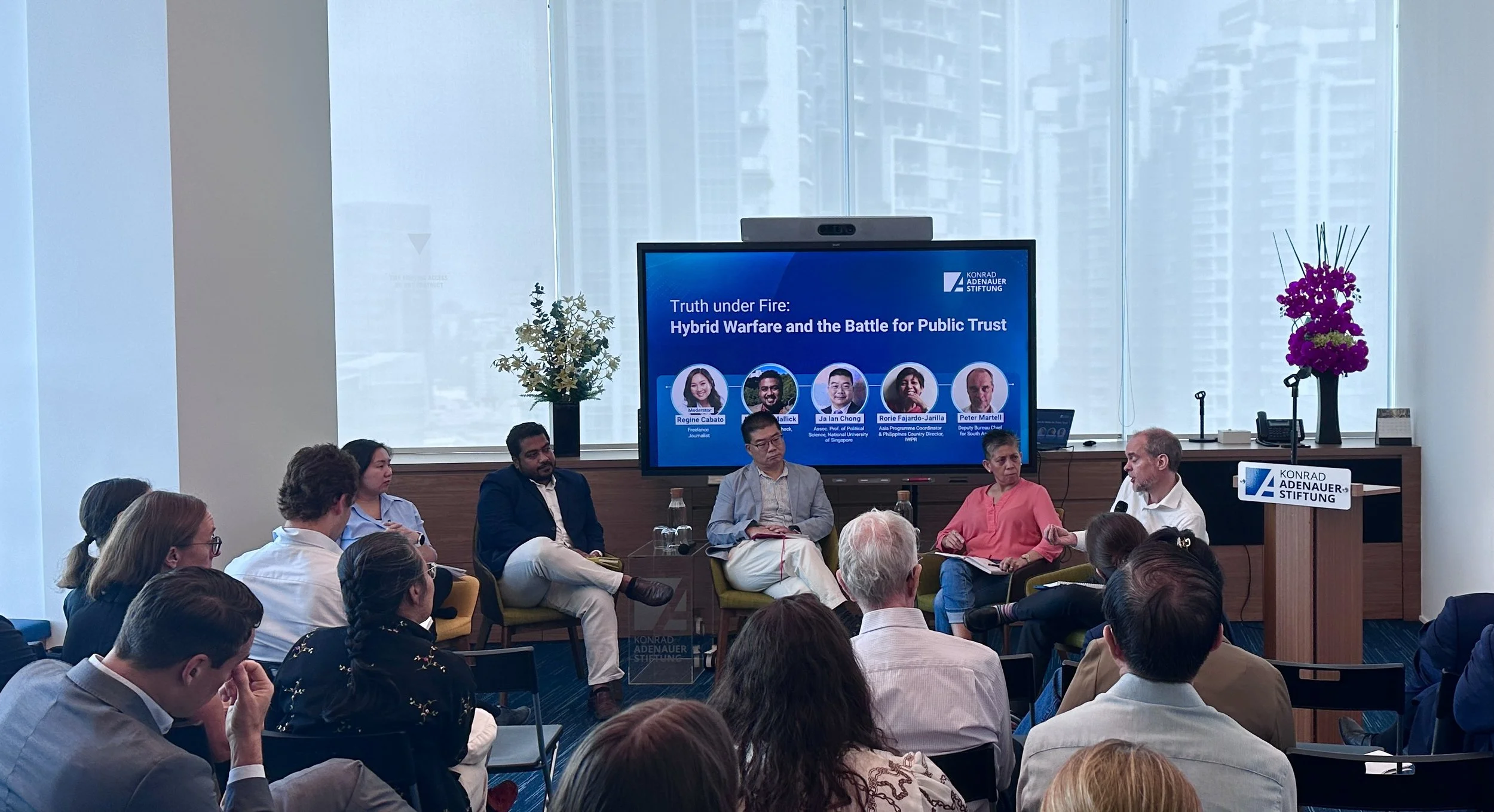
Truth Under Fire: Hybrid Warfare and the Battle for Public Trust, Panel Discussion, 3 July 2062
On Friday, 3 July 2026, Konrad-Adenauer-Stiftung hosted a panel discussion, Truth Under Fire: Hybrid Warfare and the Battle for Public Trust, featuring moderator Regina Cabato of The Washington Post, alongside Abhilash Mallick (The Quint), Assoc. Prof. Ja Ian Chong (National University of Singapore), Rorie Fajardo-Jarilla (Institute for War and Peace Reporting) and Peter Martell (Agence France-Presse).
One idea surfaced repeatedly throughout the discussion. Although each speaker approached it from a different perspective, they similarly concluded that: The battle has shifted from persuading people of lies to persuading them that truth itself is unknowable.
Imagine that. We are moving beyond post-truth to a world in which truth itself becomes unknowable.
Also, the panel didn't warn about misinformation; instead they discussed something much more profound.
Modern information warfare no longer succeeds by convincing people of a falsehood. It succeeds by creating so much uncertainty that citizens stop believing anyone.
There was a time when propaganda sought to convince us: Believe our version.
Today, trust is the target.
𝗔𝗜 𝗰𝗵𝗮𝗻𝗴𝗲𝘀 𝘁𝗵𝗲 𝗼𝗯𝗷𝗲𝗰𝘁𝗶𝘃𝗲
AI doesn't create the problem. It accelerates it.
Abhilash Mallick, Head of Fact Checking at The Quint, captured the shift perfectly:
"Now it's not just making you trust that something is real. It's making people trust that something is not real."
His point was that once every image, video and voice can be questioned, authentic evidence begins to lose its power. The burden is no longer simply proving something is false; increasingly, it is proving that genuine evidence is real.
𝗦𝗶𝗻𝗴𝗮𝗽𝗼𝗿𝗲 𝗶𝘀 𝗮𝗹𝗿𝗲𝗮𝗱𝘆 𝗶𝗻 𝘁𝗵𝗲 𝗶𝗻𝗳𝗼𝗿𝗺𝗮𝘁𝗶𝗼𝗻 𝗯𝗮𝘁𝘁𝗹𝗲𝘀𝗽𝗮𝗰𝗲
Assoc. Prof. Ja Ian Chong of the National University of Singapore argued that Singapore is already part of the information battlespace. It may not be the battlefield, but it is becoming a psychological staging ground.
He argued that narratives are seeded long before conflict begins to: create anxiety; exploit existing prejudices; erode confidence; make governments hesitate during crises. As he put it, there are: "...major power efforts to try to shape perceptions..." with the objective of: "...creating confusion... to get populations to potentially put pressure on government decision making."
That is hybrid warfare.
𝗝𝗼𝘂𝗿𝗻𝗮𝗹𝗶𝘀𝗺 𝗯𝗲𝗰𝗼𝗺𝗲𝘀 𝘃𝗲𝗿𝗶𝗳𝗶𝗰𝗮𝘁𝗶𝗼𝗻
Peter Martell, South Asia Deputy Bureau Chief for Agence France-Presse (AFP), made one of the strongest observations of the morning.
Journalists used to chase information. Now they spend their time filtering it. "What used to be a job... of seeking information now increasingly is becoming one of trying to filter out information."
Drawing on twenty years at AFP, Martell described a profound cultural shift in reporting. Increasingly, responsible journalism has to tell audiences that verification is still underway rather than speculate simply because social media has already declared something to be true.
He pointed out the irony that in an age of AI, old-fashioned reporting has become more valuable.
𝗧𝗿𝘂𝘀𝘁 𝗶𝘀 𝘁𝗵𝗲 𝗱𝗲𝗳𝗲𝗻𝗰𝗲
When the discussion turned to solutions, there was no suggestion that technology alone would solve the problem.
Mallick observed that much of today's online ecosystem exists because: "...a lot of it is created for profitability and not for the public good."
Assoc. Prof. Ja Ian Chong argued that: "...there needs to be a real effort at pushing for media literacy and public education..."
Rorie Fajardo-Jarilla, from the Institute for War and Peace Reporting, broadened the discussion beyond journalists: "...we no longer have the exclusive role in pushing back disinformation..."
She argued that trusted community figures, civil society and younger digital storytellers all have a role to play. One example she shared was work in Indonesia, where Imams were trained to use social media to counter misinformation within their own communities.
The discussion ended with a common conclusion from all four panellists: Media literacy is no longer simply an education issue. It is strategic resilience.
𝗙𝗶𝗻𝗮𝗹 𝘁𝗵𝗼𝘂𝗴𝗵𝘁
One thing I found particularly interesting was that there was almost no disagreement among the panellists. Rather than debating one another, each speaker built on the previous contribution, moving naturally from problem → strategy → operational examples → solutions.
It felt like watching a single argument unfold from four different professional perspectives.
