

CMO, PR, or Agency?
The B2B Tech Founder’s Guide to Starting Marketing and Communications
B2B tech founders often reach for the wrong tool at the wrong time. They hire a PR agency to “get us out there” before their message is well formed and coherent, then wonder why the resulting coverage doesn't convert. Or, they hire a marketing leader and expect top-tier media relationships to materialize by magic.
The roles are not interchangeable. Understanding what each function is actually built to do is the difference between burning through your capital and building genuine market momentum.
Start with the Gap, Not the Hire
When a technology company realizes it needs to "do marketing," the default instinct is to find a person or an agency and hand them the entire problem. But marketing, communications, and public relations are distinct functions designed to solve completely different problems.
Before you write a job description or sign a retainer, diagnose what is actually needed in your go-to-market engine. In scaling B2B tech, the problem usually boils down to one of three specific gaps:
Gap 1: "We don't know what we stand for." Your product does six different things, your co-founders describe it differently, and your website tries to say everything at once. Buyers can’t hold your value proposition in their heads. This is a positioning and strategy gap—the distinct domain of a marketing leader or Chief Marketing Officer (CMO).
Gap 2: "We know what we stand for, but no one has heard of us." Your message is crystal clear and your proof points are real, but the market doesn't know you exist. Journalists don't recognize your name, analysts aren't briefing you, and you're invisible in the industry conversations your buyers read. This is a visibility and credibility gap—the distinct domain of public relations and a communications agency.
Gap 3: "We have leads but no system to nurture them." People know who you are and are raising their hands, but you lack the infrastructure to turn that interest into a predictable revenue pipeline. This is a demand generation gap—a completely separate discipline that should usually be the last of the three to receive major investment.
The Core Principle: Match the role to the gap. A visibility problem solved with a strategy hire wastes months of execution time. A positioning problem handed to a PR agency simply produces incredibly confident messaging about the wrong thing.
CMO vs. PR Agency: Defining Centers of Gravity
The CMO and the PR agency are frequently confused because both touch "marketing" and both shape public perception. However, their operational scopes are entirely different. One owns the entire marketing function and sets the strategic direction; the other executes a deep, specialized part of it: earned reputation.
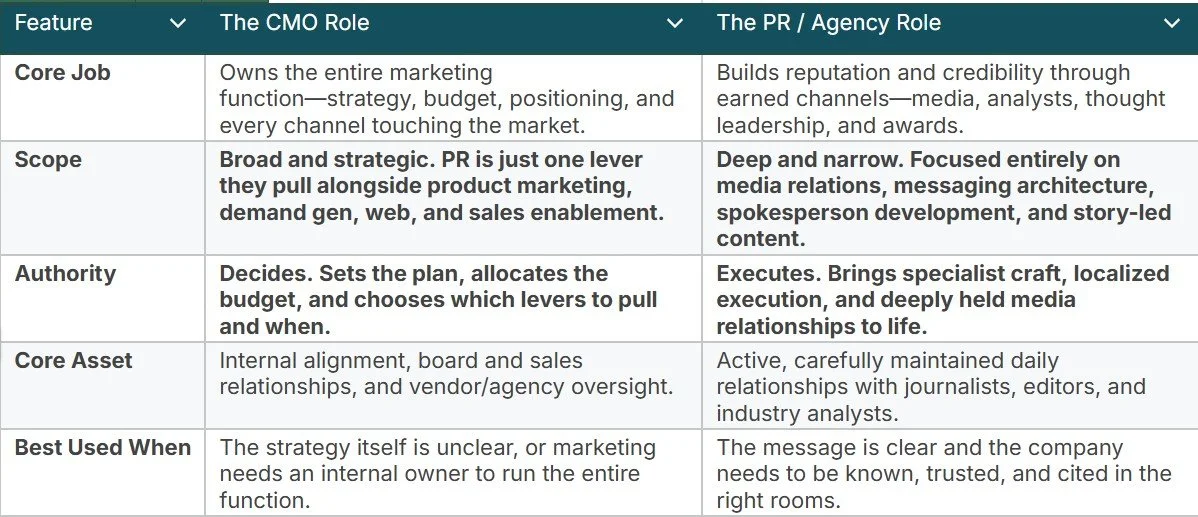
The CMO’s role and responsibility as compared to that of Communications and Public Relations.
Communications Priorities Sequence: Message, Visibility, Demand
Trying to fix every gap simultaneously is the fastest way to waste your marketing spend. For B2B tech companies, the order of operations matters far more than the size of the check. We propose this strict, logical sequence to prioritise budget spend and marketing-communications priorities:
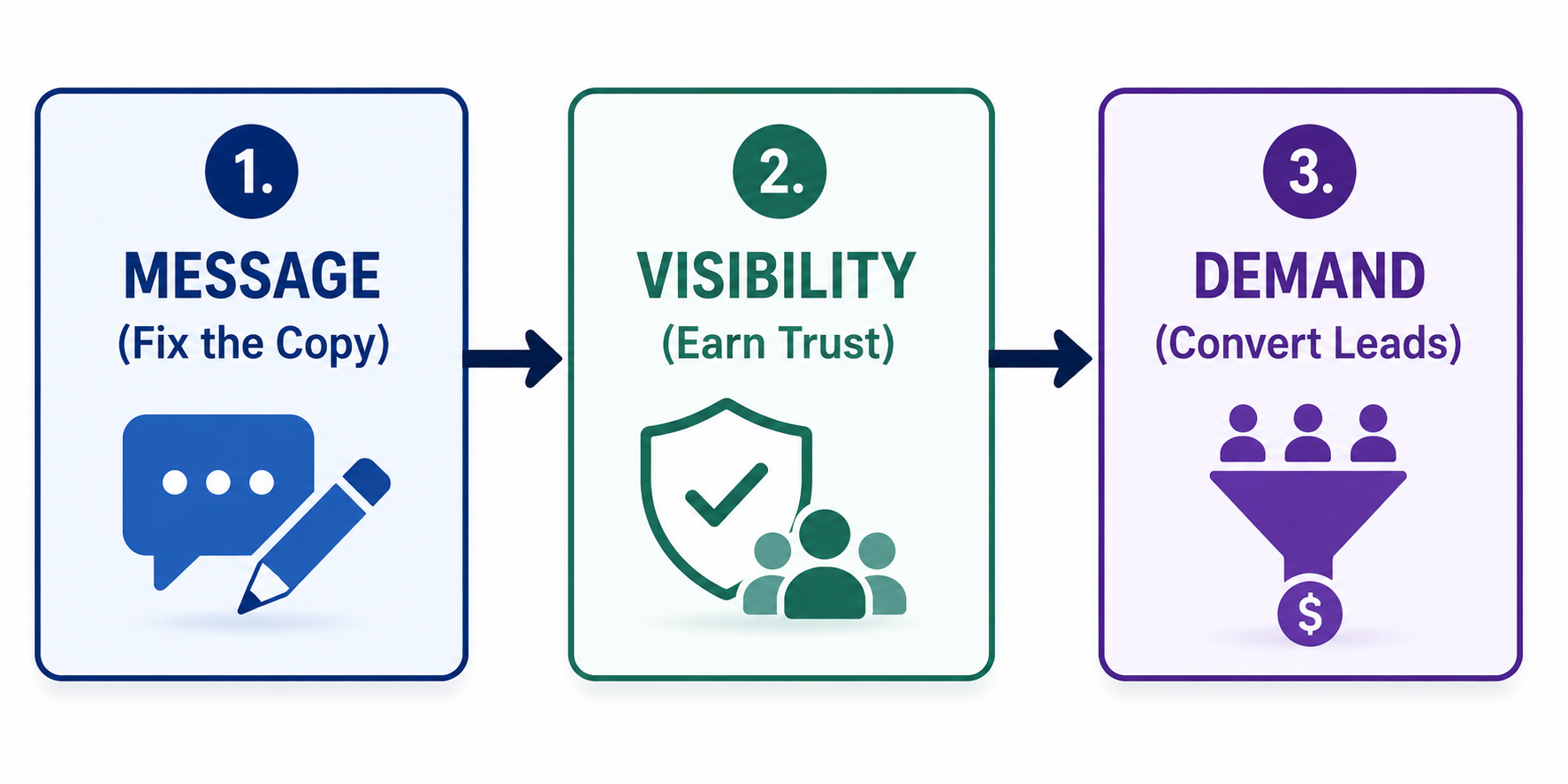
B2B Tech Founders should use this sequence - Message, Visibility, Demand - to determine their marketing and public relations priorities in a go-to-market strategy.
1. Fix the Message First
Visibility built on top of an unclear message simply spreads confusion at scale. Securing media coverage that describes your platform inconsistently is worse than having no coverage at all, because it actively teaches the market the wrong thing about you. Your positioning must be settled before it is amplified.
2. Build the Visibility Second
Once your message is locked and your proof points are verified, a PR agency’s relationships can do their work. This phase makes your founders credible, your brand findable, and your company trusted by buyers and analysts. Keep in mind that reputation compounds over time; most B2B communication programs require around six months of consistent work before media familiarity translates into regular, unprompted coverage.
3. Layer in Demand Last
Demand generation works best when there is already a credible, recognized brand for it to convert against. Running aggressive, expensive lead generation campaigns before the market actually trusts or recognizes you is highly inefficient. Capture the room's trust before you try to harvest their contact details.
The Hybrid Model: An Escape Hatch for Fast Scaling Tech
What if you look closely and realize your company has a positioning problem and a visibility problem at the exact same time?
For early-stage or founder-led tech companies entering a new market under a hard deadline (like an urgent platform/product launch or a flagship industry trade show), there is a highly effective middle path: The Hybrid Model.
Instead of hiring a full-time executive you may not yet need, you retain a senior marketing strategist or fractional CMO to solve the positioning puzzle and set the direction part-time. Simultaneously, you deploy a specialist communications agency right underneath them to handle the heavy lifting of the earned-media and relationship programme.
This structure gives you the best of both worlds: an accountable strategic owner deciding what to say, and a resourced, highly connected engine making sure the right rooms actually hear it.
