

The Cross-Border PR Playbook
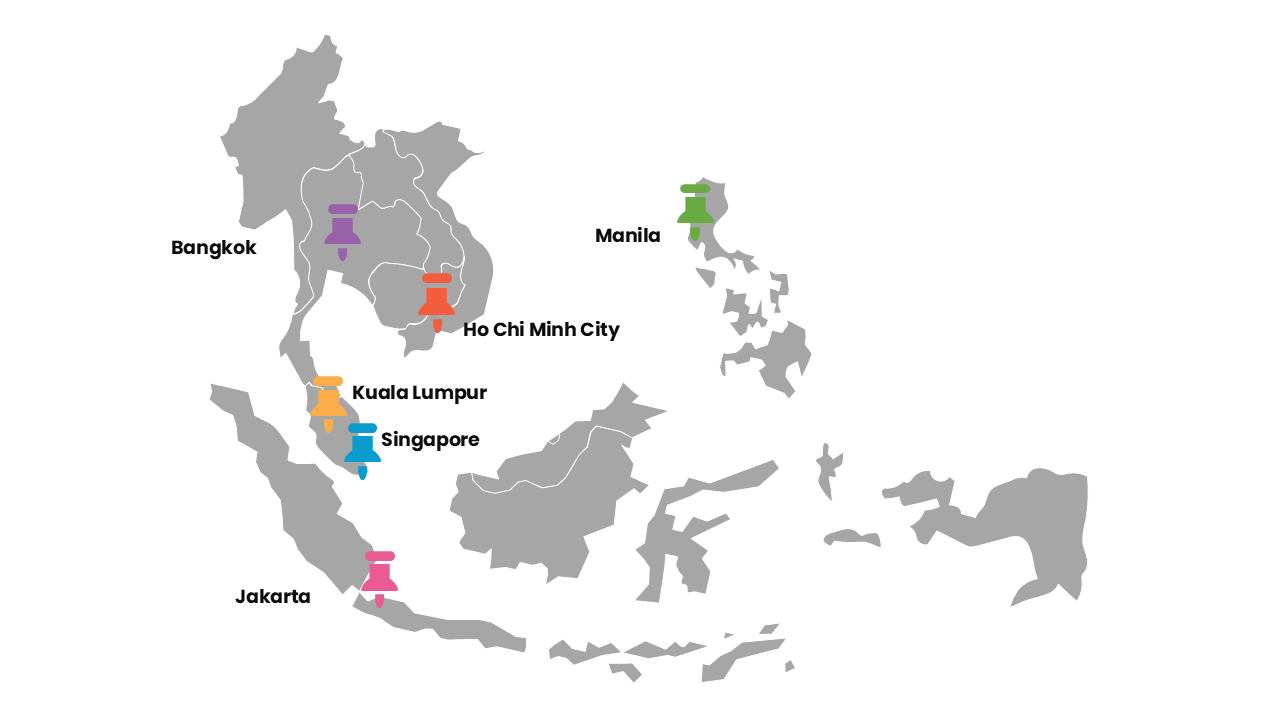
A map of the cities in which Pinpoint PR operates across Southeast Asia.
Navigating Southeast Asia’s Multi-Regulatory Media Landscape
One of the most expensive mistakes an expanding B2B Technology vendor can make is treating Southeast Asia as a single, homogenous market. While the phrase "APAC expansion" looks neat on an investor deck, the operational reality is closer to a highly fragmented patchwork of distinct languages, vastly different newsroom cultures, and contrasting regulatory pressures.
To scale effectively across Singapore, Malaysia, Indonesia, the Philippines, and Thailand, global B2B brands must consider a highly disciplined Hub-and-Spoke model that balances unified narrative control with deep local execution.
Hub-and-Spoke Model
Operating a multi-market campaign without an anchor point leads to fragmented messaging and diluted brand equity. A modern cross-border PR strategy places Singapore as the strategic "Hub," with in-country local-language teams serving as the execution "Spokes".
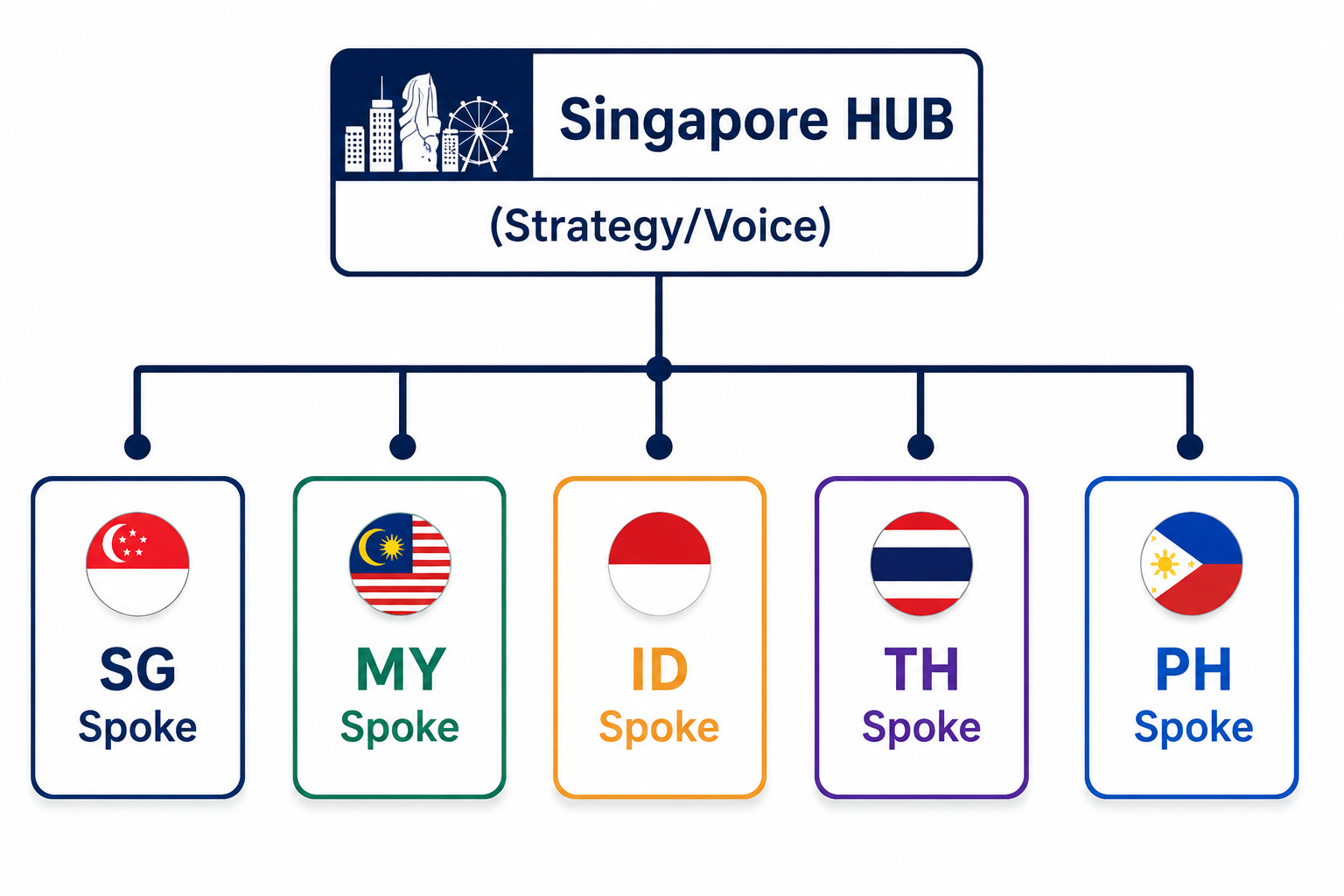
For international B2B Tech Vendors entering Southeast Asia, a Hub and Spoke Model, centering public relations from Singapore is recommended.
The Hub is responsible for defining the overarching message house, maintaining global corporate brand standards, and coordinating cross-border timelines. The Hub manages senior analyst relationships (such as regional briefs with Gartner, IDC, or Forrester) and acts as the single point of contact for the corporate client, eliminating the administrative friction of managing five separate local agencies.
In-Country Spokes are designed to handle execution and media relations locally, as well as manage localisation of content. A story that hits the front page of a business weekly in Singapore requires an entirely different angle to land in a tier-one publication in Jakarta or Bangkok. The local Spokes understand localized news cycles, cultural nuances, and individual journalist preferences intimately.
Navigating the Regional Regulatory & Media Matrix
To build a high-conversion B2B brand in ASEAN, your narrative must directly address the shifting compliance landscapes governing each individual jurisdiction. Tech vendors often fail because they pitch features rather than positioning their solution within a country's regulatory survival framework.
Singapore: The Institutional Governance Benchmark
The Media Environment: Highly sophisticated, centralized, and globally minded (e.g., The Business Times, CNA, Computer Weekly APAC).
The Regulatory Shield: Driven heavily by strict frameworks like the Monetary Authority of Singapore (MAS) Technology Risk Management (TRM) guidelines.
The Narrative Play: Content must lead with structural macro-trends, robust institutional validation, and long-term enterprise governance.
Malaysia: The High-Velocity Commercial Market
The Media Environment: A robust mix of business-focused media and fast-moving digital tech titles (e.g., The Edge Malaysia, Fintech News Malaysia, Digital News Asia).
The Regulatory Shield: Governed strictly by Bank Negara Malaysia’s (BNM) Risk Management in Technology (RMIT) policy.
The Narrative Play: The market responds rapidly to agile, practical proof-of-concept stories and immediate commercial utility.
Indonesia: The Hyper-Localized Ecosystem
The Media Environment: VAST, decentralized, and heavily dependent on localized vernacular networks (e.g., Kontan, Bisnis Indonesia, IDN Financials).
The Regulatory Shield: Influenced heavily by the Otoritas Jasa Keuangan (OJK) POJK regulations and tightening personal data privacy frameworks.
The Narrative Play: Standard English distributions fail entirely. Content must be meticulously translated into Bahasa Indonesia, framing technology as an essential driver of national digital transformation and regulatory compliance.
Philippines & Thailand: The Relationship-Driven Channels
The Media Environment: Heavily relationship-driven networks requiring consistent, localized high-touch engagement (e.g., The Manila Times, Business World, Bangkok Post, Techsauce).
The Narrative Play: Leverage established international networks operating under unified embargo disciplines to safely distribute narrative packages across local channels without leak risks.
The Cross-Border Execution Checklist
For global enterprise B2B tech brands looking to scale into the APAC market, the multi-market rollout must follow a strict sequential path:
[ ] Audit the Narrative Baseline: Map your product category within regional media to discover where existing market noise lives and identify completely unoccupied editorial lanes.
[ ] Unify the Message Architecture: Before a single pitch goes out, ensure all regional spokespeople are aligned on a single corporate architecture of claims, proof points, and analogies.
[ ] Synchronize Local Translation & Distribution: Move beyond literal translations. Ensure local teams adapt technical concepts to resonate with the specific enterprise pain points and compliance mandates of each territory.
