

Why Thought Leadership is a Whole-Funnel Tactic

Editorial: Why Thought Leadership is a Whole-Funnel Tactic (Not Just Top-of-Mind Awareness)
For decades, corporate boards have viewed B2B Public Relations through a narrow, top-of-funnel lens. It is frequently categorized as a "nice-to-have" marketing expense—a discretionary expense—a tool built exclusively for vague brand awareness, crisis management, or celebratory product announcements.
This view is fundamentally flawed. In the complex, highly regulated enterprise B2B space, authentic thought leadership operates as a high-velocity, whole-funnel engine that directly accelerates sales cycles, shortens procurement timelines, and protects existing client revenue.
Quantitative data confirms this shift. Research from the Code Red Global PR Network found 83% of Chief Information Security Officers (CISOs) in Singapore explicitly state they would pay a premium to work with an established industry thought leader.
When four-fifths of your enterprise buyers openly express a premium pricing bias toward recognized expertise, thought leadership stops being a branding luxury. It becomes a core boardroom and revenue driver.
Bypassing the Newswire Trap
To understand why thought leadership holds such significant downstream commercial power, one must look at the structural failure of standard B2B marketing. Many enterprise software vendors mistake "noise" for "influence."
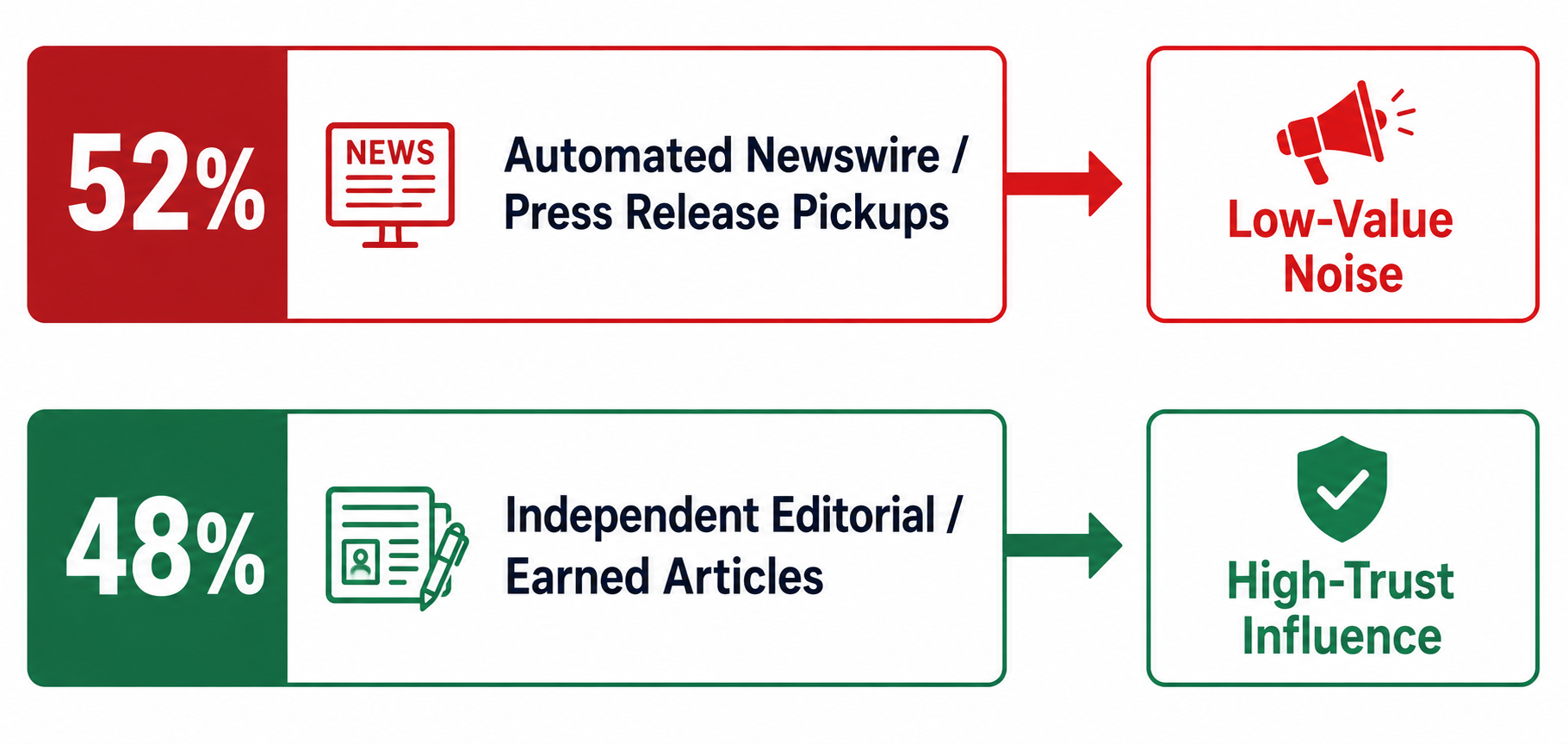
Pinpoint PR’s recent category media analysis of the regional Application Security (AppSec) landscape reveals a stark systemic reality: over 52% of all media coverage across the category is driven by automated newswire press release pickups (Source data: Muck Rack).
While category incumbents spend massive budgets flooding low-UVM syndication networks with product launch wire drops, they fail to build media relations and instead leave a massive, high-value editorial gap completely unoccupied. Genuine independent earned editorial in this particular space, is rare.
When a B2B vendor steps into that unoccupied lane with rigorous, research-driven thought leadership, they don't just add to the noise; they establish an exclusive editorial relationship with the industry.
Passing the Enterprise Permission Test
In enterprise deep tech sales, an unknown brand faces an immediate trust deficit. Corporate CISOs, CIOs, and government procurement officers will not place an unvouched vendor on a shortlist, and industry analysts will not brief a company that lacks a distinct narrative position.
To break through this barrier, thought leadership must be structured as an academic, highly technical wedge that flips the category script —moving away from merely identifying flaws to delivering outcomes.
Aligning with Structural Macro-Forces
Thought leadership should never pitch a product; it must pitch a market reality. High-value narratives link directly to acute macroeconomic and regulatory shifts that force buyers to act. For example:
The Compression of Attack Windows: Highlighting how AI-accelerated threats compress the time between vulnerability disclosure and active exploitation from months to days, creating an urgent market need for immediate virtual patching.
Regulatory Compliance Pressures: Positioning technology directly within tightening regional compliance mandates (such as MAS TRM in Singapore, BNM RMIT in Malaysia, or OJK POJK in Indonesia). When a vulnerability exposure becomes a regulatory event, compliance urgency automatically transforms into buyer urgency.
The Power of Structural Analogy
Deep-tech and enterprise software architectures are inherently complex. True thought leadership uses sophisticated structural analogies to make abstract mechanics instantly visual for non-technical boardroom stakeholders.
Building an analogy that clearly and aptly explains your narrative is helpful for editors and readers to quickly grasp what you bring to the table; and what differentiates your business proposition. It paves the way to ready acceptance.
Converting Credibility into Revenue
When a B2B brand transitions from standard feature-dumping to a robust, validation-led thought leadership architecture, the impact moves rapidly down the sales funnel:
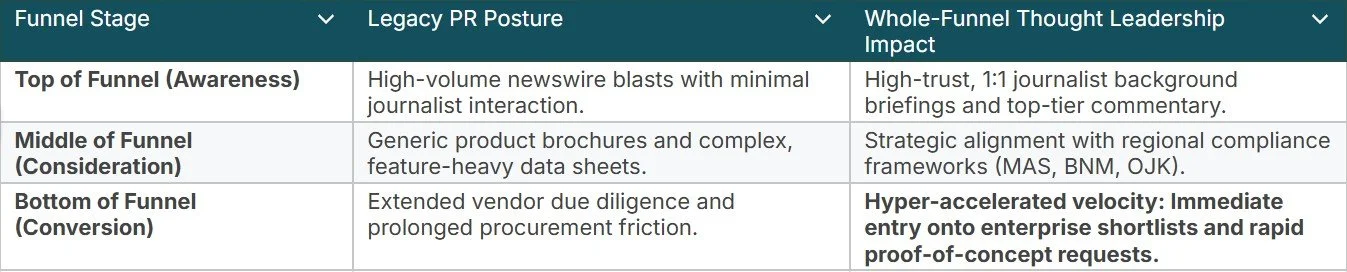
The commercial velocity generated by this approach is highly measurable. When a brand establishes authoritative credibility before major enterprise engagements, sales friction vanishes.
In practical execution, structured technical positioning has been proven to trigger immediate commercial responses—driving multiple high-value Proof-of-Value (POV) engagements within 48 hours of initial prospect meetings and accelerating design-partnership requests from mega-scale regional enterprise operators within days of message alignment.
Ultimately, high-end technical thought leadership isn't a top-of-funnel vanity metric. It is an intellectual property asset class that establishes market authority, de-risks corporate procurement, shortens complex sales cycles, and drives predictable B2B revenue.
