

Roundtables: Why Should You Use Them?

Turning Executive Facilitation into High-Yield B2B Content and Market Trust
For enterprise technology and deep science brands, breaking into a new market or launching a complex solution presents a steep uphill battle.
You cannot simply cold-email a Chief Information Security Officer (CISO), a Chief Information Officer (CIO), or a Data Innovation Officer and expect them to sit through a product demo. These high-value decision-makers are aggressively guarded by corporate gatekeepers and possess a natural allergy to transactional sales pitches.
To capture their attention, consider how Public Relations can help you change the sandbox entirely, by transitioning away from direct selling and moving toward a sophisticated stakeholder management and communications approach.
One of the most effective strategies for this transition is the Industry Roundtable. When executed correctly, a roundtable can serve as a powerful market entry wedge; and simultaneously serving as a localised intelligence-gathering exercise, an executive trust-builder, and a factory for high-yield B2B thought leadership content.
The Roundtable as an Intelligence and Learning Asset
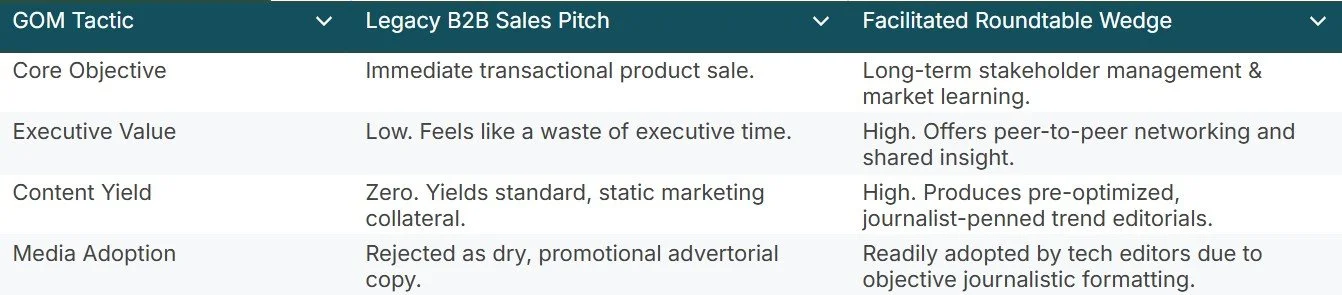
Many B2B companies view a roundtable merely as an intimate networking event. This approach completely misses its true strategic value. A roundtable should first be treated as a market intelligence and learning exercise.
When entering a new region or introducing a disruptive paradigm, your primary challenge is mapping localized anxiety. What are the specific, unvarnished bottlenecks keeping regional CIOs or risk officers awake at night? What localized regulatory pressures—such as MAS TRM in Singapore or BNM RMIT in Malaysia—are currently shifting their operational budgets?
By convening a closed-door, Chatham House Rules discussion around a high-level industry challenge, you invite enterprise leaders to talk about their problems, rather than forcing them to listen to your features. This provides your product and executive teams with an unvetted blueprint of exact buyer pain points, allowing you to calibrate your regional messaging with absolute precision.
Journalism: De-risking Content for Editors
The true PR magic happens after the dinner plates are cleared. The closed-door insights gathered from your executive cohort can be converted into high-value trend editorials that target the wider industry. However, if your internal marketing team writes this wrap-up report, it will inevitably read like an advertorial—and tech editors will reject it out of hand.
To transform a closed-door session into a highly authoritative, publication-ready editorial, you must deploy a unique operational blueprint:
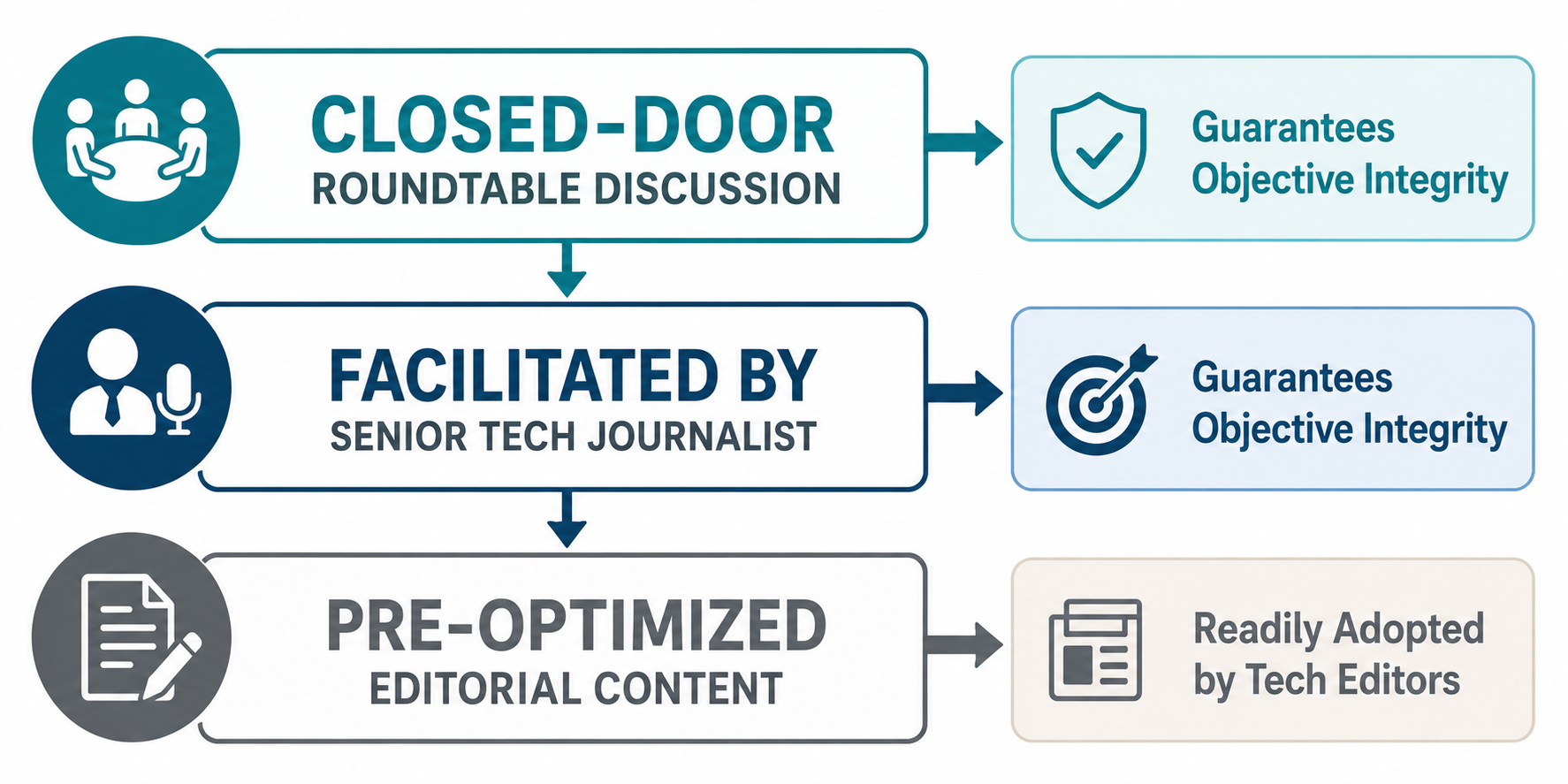
Independent Facilitator: Appoint a senior, highly respected specialist journalist to moderate the roundtable discussion.
Because a journalist leads the conversation, the dialogue naturally maintains editorial integrity rather than devolving into a sales pitch. The journalist then drafts the subsequent thought leadership editorial based on the aggregated, anonymous trends discussed in the room.
Editorial Result: Because the content is penned by a trusted industry journalist and focuses on real, unfiltered peer insights, editors of target publications will more readily adopt and publish the piece. Your brand sits at the center as the convener of the conversation, gaining massive market authority without writing a single line of self-congratulatory copy.
Ecosystem Partnership Model
Building an executive guest list from scratch is incredibly resource-intensive. To scale this strategy effectively, you should actively partner with trusted third parties, media titles, and established event organizers who already own the exclusive attention of your target audience.
Instead of fighting for access, you collaborate with ecosystem partners who manage specific reader and membership categories—spanning CISOs, CTOs, CIOs, CEOs, and Data Innovation Officers.
Work alongside a premium event or media partner to co-convene the roundtable. The partner handles the algorithmic and relationship-driven audience matching, bringing their pre-qualified executive network to the table. Your brand acts as the strategic sponsor and subject matter expert, presenting a macro-solution to an industry-wide issue rather than pitching a product.
This approach completely reframes the dynamic. You are no longer a vendor begging for a meeting; you are an industry peer facilitating a crucial, face-to-face dialogue regarding shared regulatory, operational, or technical risks.
Direct Sales Pitches vs. Facilitated Roundtables
Roundtables for B2B Growth
If you want to win the trust of the modern C-suite, stop trying to sell to them from a distance.
Deploy the roundtable framework to listen first, synthesize their insights through the lens of independent journalism, and partner with the ecosystems they already trust.
By focusing on stakeholder management rather than transactional conversion, you establish an undeniable market presence that permanently shortens enterprise sales friction
